Updated for the 2026/27 tax year

Work out your tax as a sole trader, and pay the right amount on time.

A free calculator for Income Tax, Class 4 National Insurance and payments on account, plain-English guides, and a step-by-step pack when you want the dates and planners in one place.

Free, no account or email needed. Independent, not HMRC.

Updated for 2026/27

Sole Trader Tax Calculator UK 2026/27

Estimate your self-employed Income Tax, Class 4 National Insurance, take-home profit and monthly tax set-aside for 2026/27. On £30,000 of profit a sole trader pays £3,486 Income Tax and £1,045.80 Class 4 NI and keeps £25,468. Enter taxable profit, not turnover.

Updated for 2026/27. Uses UK tax bands and HMRC/GOV.UK guidance. Estimates only — not tax advice.

Calculator checked against GOV.UK and HMRC rules on (how we check).

Self Assessment estimateMonthly tax reserveStudent loan optionalPension optional
2026/27 tax year England, Scotland, Wales & NI Student loan support Practical reserve figure

Sole trader tax calculator

Self-employed tax estimate

Adjust inputs below — results update instantly.

Tax year 2026/27
How do you earn?

Enter profit after allowable business expenses — not total turnover.

The annual profit used in calculations will be monthly profit × 12.

£
£
Expenses exceed estimated turnover — check your inputs.
£
£
Expenses exceed estimated turnover — check your inputs.
£
Taken off your take-home as money you pay out. The Income Tax relief on it is not added.
£
A job or pension. Tax on it is treated as already paid.
£36,568take-home / year£3,047/mo
Monthly net
£3,047
Tax set-aside
£703
Quarterly reserve (estimate)
£2,108
Take-home£36,568
Income Tax£6,486
National Insurance£1,946
Student loan£0
Pension£0
Show detailed breakdown ▼
Income tax£6,486.00
Class 4 National Insurance£1,945.80
Student loan£0.00
Pension contribution£0.00
Take-home after tax£36,568.20
Monthly tax set-aside£702.65
Share this result
HMRC 2026/27 · Methodology

Employed too, or a company director? Browse all 7 packs in the Tax Pack Library  · £9.99

Key figures

  • Income Tax is 20% from £12,570 to £50,270, 40% to £125,140 and 45% above, for 2026/27 and 2027/28 (rest of the UK). Budget 2026 Annex A
  • Class 4 National Insurance is 6% on profits from £12,570 to £50,270 and 2% above. Budget 2026 Annex A
  • With profits of £7,105 or more, Class 2 National Insurance is treated as paid; below that it is voluntary, at £3.65 a week in 2026/27. GOV.UK

Checked 1 November 2026.

Help with your tax return

The calculator and guides are free. If you want the 2026/27 rules, dates and planners in one place, there are two optional downloads.
Free check · optional report, 7 to 8 pages Your tax bill and payment plan See your 2026/27 bill, your payments on account and every payment date with its amount, from January 2027 to July 2028. Plan my payments →
Self-employed and doing your tax return?

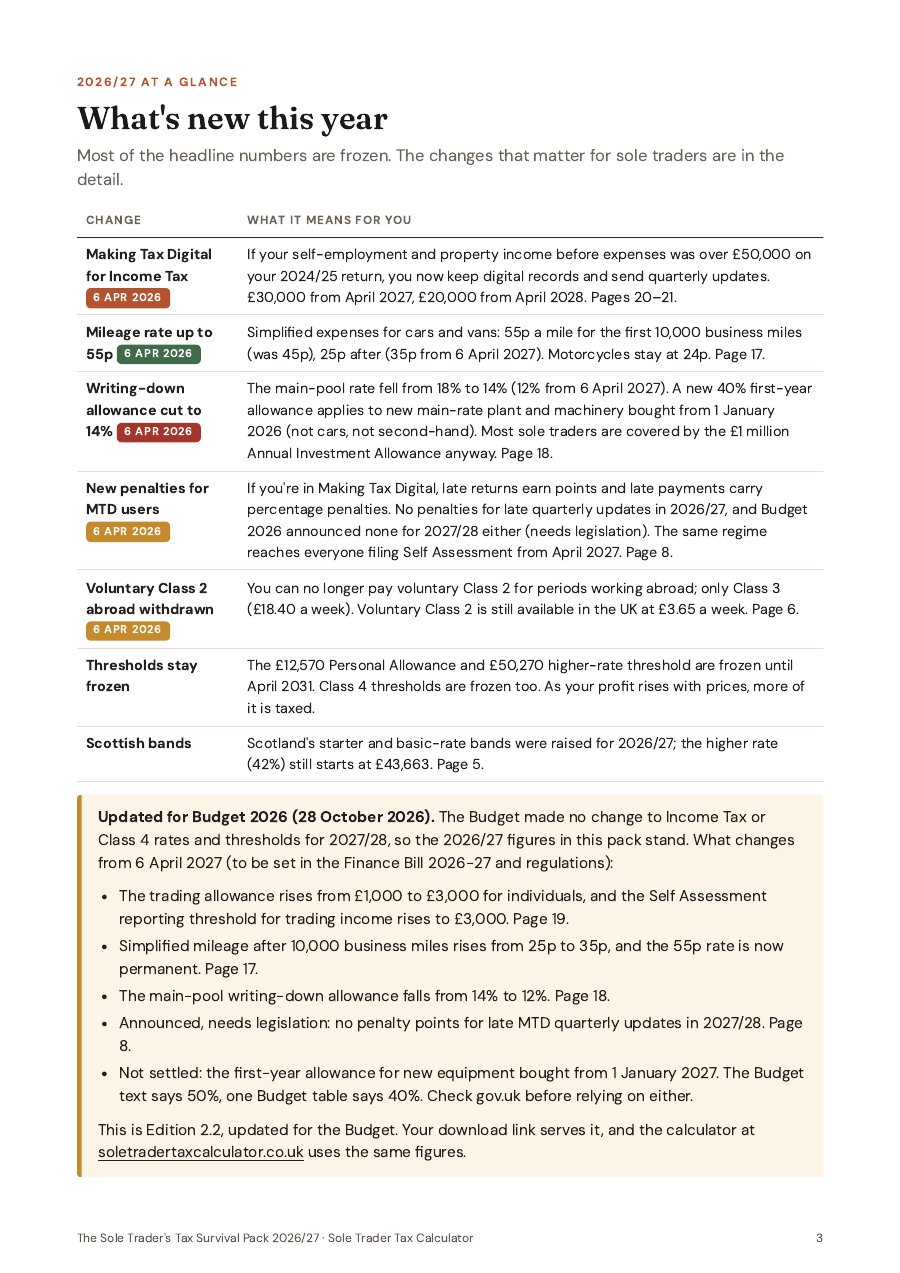
The Sole Trader’s Tax Survival Pack

30 pages · printable planners

Your 2026/27 Income Tax and National Insurance, the dates and penalties, and printable planners, in plain English.

  • Worked examples from £20,000 to £110,000
  • Payments on account, with a first-year timeline
  • A set-aside planner and allowable expenses list
See what’s in the pack →

£4.99 one-off · instant download · full refund on request

Updated for Budget 2026 (28 Oct).
Employed too, or a company director?

The 2026/27 Tax Pack Library

7 packs · 207 pages in all

All seven of our 2026/27 tax packs: sole trader, director’s pay, pensions, Capital Gains Tax, home buying, PAYE tax codes and new starters.

  • Seven plain-English packs for 2026/27
  • Download one at a time or all in one ZIP
  • One payment, no subscription
See the seven packs →

£9.99 one-off · instant download · full refund on request

Filing your Self Assessment on GOV.UK is free, and HMRC’s guidance is free too. These downloads are optional. Not sure which fits? Compare them.

Free check · 2026/27

Plan your tax payments for 2026/27

See your 2026/27 bill, every payment with its date and amount, and what to set aside each month.

A job or student loan too?
Quick answer

How much tax does a sole trader pay in 2026/27?

A sole trader pays Income Tax (20%/40%/45% above the £12,570 allowance) plus Class 4 NI (6% then 2%) on profit after allowable expenses. The sole trader tax rates for 2026/27 page sets out each band with the profit it applies to.

Tax-free allowance
£12,570
Income Tax bands
20% / 40% / 45%
Class 4 NI
6% then 2%

Tax is charged on your profit after allowable expenses, not your turnover. These are the 2026/27 figures for England, Wales and Northern Ireland, with no other income.

Sole trader tax by profit, 2026/27 (England, no other income)
ProfitIncome TaxClass 4 NITake-homeOverall rate
£20,000£1,486£446£18,0689.7%
£30,000£3,486£1,046£25,46815.1%
£40,000£5,486£1,646£32,86817.8%
£50,000£7,486£2,246£40,26819.5%
£60,000£11,432£2,457£46,11123.1%
£80,000£19,432£2,857£57,71127.9%

Class 2 NI is not charged: it has been voluntary since 6 April 2024. Enter your own profit above to add Scotland, a student loan, pension contributions or other income.

Payments on account

Your Self Assessment payment timeline

Based on your estimated bill of £8,431.80 for 2026/27, here is when HMRC expects payment — and why your first January bill can feel much bigger than the tax itself. Estimate only — your exact HMRC figures may differ.

31 January 2028
£12,648
Balancing payment £8,432 + first payment on account £4,216
31 July 2028
£4,216
Second payment on account
Following 31 January 2029
£4,216
Next balancing payment + first payment on account for the following year
Tax year
ends 5 Apr
31 Jan 31 Jul Next
31 Jan
Set aside each month (ongoing)
£703/mo
Set aside in your first payment-on-account year
£1,405/mo
Why your first Self Assessment payment can feel higher
The first time you owe £1,000 or more, your 31 January bill includes two things: the full tax bill for the year just finished (the "balancing payment"), plus your first payment on account towards the next year — normally half of this year's income tax and Class 4 NI. That combination is why the first January can feel like roughly 150% of the tax itself.
What payments on account are
Payments on account are advance payments towards your next Self Assessment bill. There are usually two — one due 31 January and one due 31 July — and each is normally half of your previous year's income tax and Class 4 National Insurance. (Class 2 NI, student loan repayments and Capital Gains Tax are not included in payments on account; they are paid in the balancing payment.)
When you might not need to make them
You normally do not make payments on account if your last Self Assessment bill (income tax and Class 4 NI) was under £1,000, or if more than 80% of the tax you owe was already collected at source (for example through PAYE). You may also be able to ask HMRC to reduce your payments on account if you expect your next bill to be lower — but reducing them too far can lead to interest, so check your figures carefully.
Why your exact HMRC bill may differ
This is an estimate based on the figures you entered. Your real Self Assessment bill depends on your full tax position, allowable expenses, other income, reliefs and any adjustments. Always check your actual figures in your HMRC online account before making a payment. This tool does not give personalised tax advice.

HMRC-based sole trader tax estimate for quick planning

Estimates sole trader income tax and Class 4 National Insurance on taxable profit for 2026/27. Enter profit after allowable business expenses — not turnover. Results are for planning only. See the methodology for full assumptions.

Rates checked against Budget 2026 Annex A on 30 October 2026. Written and reviewed by James Whitfield against current GOV.UK and HMRC guidance. Results are estimates for planning only and are not tax, accounting or financial advice.

Updated for 2026/27 HMRC / GOV.UK rates Estimate only — not advice See methodology

Popular sole trader searches

More calculators

Sole trader guides

See all sole trader guides or the sole trader tax blog.

UK sole trader tax explained

Income tax and Personal Allowance
Sole traders pay income tax on taxable profit above the Personal Allowance (£12,570 for 2026/27). The basic rate (20%) applies up to £50,270, the higher rate (40%) up to £125,140, and the additional rate (45%) above that. Scottish taxpayers have different band thresholds.
National Insurance for sole traders
Self-employed people pay Class 4 National Insurance contributions: 6% on profits between £12,570 and £50,270, and 2% above £50,270. Compulsory Class 2 NI ended from 6 April 2024 (voluntary Class 2, £3.65 a week in 2026/27, is still available if profits are under £7,105). Class 4 NI is paid via Self Assessment alongside income tax.
Profit, turnover and allowable expenses
Turnover is your total business income before expenses. Taxable profit is what remains after deducting allowable business expenses such as software, equipment, travel for business, professional fees and a reasonable use-of-home proportion. Tax is calculated on profit, not turnover.
Self Assessment and payments on account
Sole traders file a Self Assessment return each year and pay any tax due by 31 January. If your bill is £1,000 or more, you may also need to make two payments on account (each 50% of the previous year's bill) in January and July. The monthly set-aside figure helps you plan for this.
Making Tax Digital for sole traders
Since 6 April 2026, sole traders and landlords whose qualifying income (self-employment and property income before expenses) was over £50,000 on their 2024/25 return must keep digital records and send HMRC quarterly updates from compatible software. The threshold falls to £30,000 from April 2027 and £20,000 from April 2028. Quarterly updates are reports, not payments: tax is still paid on 31 January and 31 July.
Sole trader vs limited company
A sole trader structure is simpler to run. On 2026/27 rates, a limited company that pays out all its profit rarely leaves you with more once corporation tax, dividend tax and accountancy costs are counted; incorporating mainly helps when you can leave profit in the company, or when clients require one.

UK sole trader tax 2026/27 — common profit levels

Taxable profitEst. income taxEst. Class 4 NIEst. take-homeMonthly set-aside
£20,000£1,486£446£18,068£161
£30,000£3,486£1,046£25,468£378
£40,000£5,486£1,646£32,868£594
£50,000£7,486£2,246£40,268£811
£60,000£11,432£2,457£46,111£1,157
£75,000£17,432£2,757£54,811£1,682
£100,000£27,432£3,257£69,311£2,557

2026/27 estimates. England/Wales/NI tax rates. No student loan, no pension, no other income. Approximate figures only.

Sole trader tax — common questions

How much tax does a sole trader pay?
A sole trader pays income tax on taxable profit above the Personal Allowance (£12,570 for 2026/27) at 20%, 40% or 45%, plus Class 4 National Insurance at 6% on profits between £12,570–£50,270 and 2% above £50,270. The exact bill depends on profit level, region, student loan plan and pension contributions.
Is sole trader tax based on turnover or profit?
Tax is calculated on taxable profit after allowable business expenses — not on total turnover. Enter your net profit into this calculator, not gross revenue. If you are not sure of your profit, subtract realistic business expenses from your expected turnover first.
Does this calculator include National Insurance?
Yes. The estimate includes Class 4 National Insurance contributions for 2026/27. Compulsory Class 2 NI ended from 6 April 2024 (voluntary Class 2, £3.65 a week in 2026/27, is still available if profits are under £7,105). The breakdown shows NI separately so you can see the full tax-plus-NI picture.
How much should I set aside for tax?
A common guide is 20–30% of profit, but the exact figure depends on your income level and deductions. This calculator gives a specific monthly set-aside amount based on your estimated income tax and NI combined. Keeping this in a separate bank account avoids cashflow surprises at Self Assessment time.
Does this include payments on account?
Yes — see the Payments on Account timeline above. Payments on account are advance payments towards your next Self Assessment bill, normally two per year (due 31 January and 31 July), each 50% of your previous year's income tax and Class 4 National Insurance. The timeline shows your schedule, why the first January can feel like roughly 150% of the tax, and a suggested monthly set-aside. Student loan repayments and Class 2 NI are not included in payments on account. Always check current GOV.UK guidance. The Sole Trader Tax Survival Pack includes a payments on account calendar.
Do sole traders need Making Tax Digital?
Yes, if your qualifying income is over the threshold. Making Tax Digital for Income Tax has applied since 6 April 2026 to self-employed people and landlords with qualifying income over £50,000 on their 2024/25 return; it extends to over £30,000 from April 2027 and over £20,000 from April 2028. Qualifying income is turnover, before expenses. GOV.UK explains how to check.
Should I stay sole trader or go limited?
The decision depends on profit level, how much you want to extract, admin tolerance, pension strategy and long-term plans. At lower profit levels, the simplicity of sole trader often outweighs any tax saving from incorporating. See our sole trader vs limited company guide to weigh both structures.
Is this tax advice?
No. All results are estimates for planning and comparison purposes only. They are based on published 2026/27 HMRC rates and a simplified model. For Self Assessment filing, tax planning advice or compliance decisions, consult a qualified accountant or HMRC directly.

Three steps to a sole trader tax estimate

01
Enter your profit
Use annual, monthly, day rate or hourly mode. Always enter taxable profit after allowable business expenses — not turnover.
02
Review deductions
The estimate breaks out income tax, Class 4 NI and optional deductions including student loan and pension contributions.
03
Use the set-aside figure
The monthly set-aside and quarterly reserve help you build cash for Self Assessment throughout the year.
Methodology
The full set of HMRC rates, assumptions and formula notes used in this calculator.
Guides
Expenses, payments on account, Making Tax Digital and the sole trader vs limited company comparison.
Planning estimates only
Not tax advice, not a filing tool. For formal advice or filing, use a qualified accountant or HMRC directly.

HMRC and GOV.UK sources

All tax figures are estimates based on published HMRC rates for 2026/27. Results are for planning purposes only and should not be used as the basis for filing or formal tax advice.

MTD for Income Tax

From 6 April 2026, Making Tax Digital for Income Tax is mandatory for sole traders and landlords with qualifying income over £50,000. That means keeping digital records and sending HMRC quarterly updates through compatible software, and still filing a tax return by 31 January after the tax year ends. The threshold drops to £30,000 in April 2027 and £20,000 in April 2028, and HMRC reckons around 860,000 people are in the first wave.

HMRC-recognised software includes FreeAgent, Xero, QuickBooks, Sage and Zoho Books. FreeAgent is free for Mettle and NatWest business banking customers. There are no penalty points for late quarterly updates in 2026/27, or in 2027/28 for people who must join in April 2027 (Budget 2026). Updates are still required, and late tax return penalties still apply.

Business bank accounts

Keeping a separate account for business income and expenses makes Self Assessment and record-keeping considerably easier.

Starling Business
Permanently free, no monthly fee. A fully licensed UK bank - eligible deposits are FSCS protected up to £120,000 per eligible depositor, per authorised bank (brands sharing one banking licence share one limit). As a sole trader your business and personal accounts at the same bank count towards one £120,000 limit. Accepts sole traders and limited companies. 0.7% on Post Office cash deposits.
Open an account →
Tide
Free to open. Built-in invoicing and expense tracking. 20p per outgoing transfer on the free tier. Accepts businesses with no trading history. Funds are safeguarded as e-money, not FSCS protected.
Open an account →
Mettle by NatWest
Free for sole traders and single-director limited companies. Includes FreeAgent bookkeeping at no extra cost - useful for MTD record-keeping. Funds safeguarded as e-money, not FSCS protected. No cash deposits.
Open an account →

More from our free tools

Read next